An Enterprise Architecture Guide For Post Quantum Readiness
This guide explains how organisations can prepare for post-quantum cryptography by building the governance and operating model needed to manage cryptographic change.
A practical playbook for Heads of Cryptography, Security Architecture and Compliance teams: how to turn an inventory of cryptographic assets into a prioritised, funded remediation programme.

WHAT A SINGLE APPLICATION CAN DEPEND ON
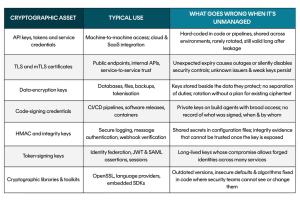
Table 1: Typical cryptographic dependencies of an enterprise application (illustrative, not exhaustive).
Multiply a handful of such dependencies by a few hundred applications and several environments, and the estate holds tens of thousands of cryptographic objects or assets. Each needs an owner, an approved configuration, a lifecycle and evidence. When every team chooses its own library, key store and rotation practice, the organisation does not have one cryptographic posture, it has many separately managed implementations, with inconsistent oversight and lifecycle practices.
POORLY MANAGED CRYPTOGRAPHY ALREADY HAS A TRACK RECORD
These incidents show how weaknesses in key and certificate management can contribute to serious security failures.
Organisations need evidence that their cryptographic policies are implemented, maintained and reviewed as threats and technology change.
This requires an authorised process for enforcing decisions, managing changes and retaining evidence. The legal provisions below support that argument within their respective scopes. They do not establish one universal PQC mandate or require a particular control platform.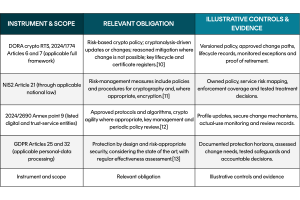
Table 2. Selected EU obligations and the agility evidence that supports them.
Applicability depends on entity, sector and national law. Our conclusion is architectural: organisations must be able to control and enforce cryptographic policies. Controlled change and real time visibility is a strong way to implement these expectations.
See how a Tier 1 bank reduced hardware costs and freed up budget for post-quantum readiness.

Discovery and inventory tell the organisation which cryptographic assets it holds: keys, certificates, secrets, algorithms, security protocols, cryptographic libraries and the systems that use them. As part of the inventory, the identified cryptographic assets are usually mapped together to draw cryptographic dependencies.
This step is very much important to apprehend the security exposure of a full business flow e.g. signed data set is produced by application A and verified in application C and D. A change requires checking whether applications C and D can accept the new signature profile and updating them where necessary. While looking at this process, it is paramount to assess the business risks if the authenticity or integrity of the data set would be compromised. Discovery shows what you own and where you stand against compliance goals.
It delivers CBOM, maps dependencies, helps define a cryptographic policy. The decisive work is hands-on: finding the business flows that are most exposed and implementing changes that reduce the identified exposure, through governed services and enforceable policy. This helps business leaders set remediation priorities and a recommended way forward.
In practice, making a business flow post quantum ready will include different steps involving architects, service owners, developers, suppliers and crypto specialists:
1) Combine the discovery methods available for the flow: from initiation to archive across applications, gateways, data stores, partners and suppliers. This requires examining network traffic, parsing source code, configurations, protocols etc.
2) Locate every cryptographic decision point: in code, configuration, libraries, HSMs and KMSs, certificates and protocols. Note who can change each one.
3) Build the CBOM: A CBOM (Cryptographic Bill of Materials) is a structured inventory of cryptographic assets - algorithms, keys, certificates and protocols- and their relationships to applications and systems. During discovery, people are often surprised by the amount of cryptographic assets that are difficult to interpret.
4) Before remediation, it is important to assess the exposure of the business flow (not the total assets count)
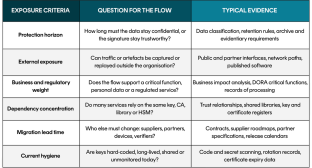 Table 3: Criteria for selecting the most exposed business flows.
5) Establish what breaks when the algorithm changes: message and certificate sizes, formats, verifiers, stored ciphertext and signatures, partner endpoints and performance.
6) Select the treatment: Decide whether to update, refactor, introduce a shared service, replace, retire or temporarily mitigate the affected implementation. Record the reasons and remaining dependencies.
7) Assign delivery responsibilities: Name the delivery owner, identify required approvals and agree supplier or partner actions and rollout constraints.
8) Implement and test: Check functionality, interoperability, permissions, performance and failure behaviour against agreed acceptance criteria.
9) Deploy and verify: Observe actual cryptographic use, retire obsolete mechanisms where appropriate and document any remaining exceptions.
llustrative example: a payment-initiation API:
What the inventory shows: 14 certificates, three RSA keys and two cryptographic libraries attached to the service.
What the flow analysis reveals: payment instructions are signed with an RSA key stored in application configuration; the signatures are archived for ten years for dispute handling; a partner bank verifies them with its own library; mTLS terminates at a shared API gateway used by 40 other services.
The exposure of the flow: This is a high-priority flow combining potential signing-key exposure, ten-year evidentiary risk, partner-dependent migration and a shared gateway whose disruption could affect 41 services.
When algorithm choices, key locations and lifecycle rules are tightly coupled to application code, cryptographic changes require coordinated work across application teams. A shared cryptographic service can centralise selected responsibilities and provide consistent interfaces for approved operations. Its value depends on which responsibilities it assumes and how the remaining dependencies are managed.
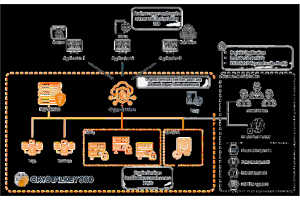
Figure 1. Crypto agility reference architecture: applications send cryptographic commands to a central service that verifies each request against policy, uses governed keys and executes across HSMs, while service administration registers applications and assigns policy and keys.
The architecture in Figure 1 has different responsibilities. Business apps express operations through approved interfaces. A Service administration defines application access control, manages policies (including algo change), manages key and certificate association (including rekey, rotation or reshape). It also typically monitors execution and system health through integration with central SIEM or ITSM. The CrystalKey 360 Services ensure smooth execution under high performance requirements.
The application no longer maintains cryptographic assets locally but CrystalKey 360 Services maintain them centrally and can produce a live CBOM. This reduces drastically the cryptographic exposure of the application as it simply knows the cryptographic intent and not the cryptographic primitives.
This is made possible using CQL is CrystalKey 360’s cryptographic intent interface, enabling applications to express what they need to achieve - such as encrypting data or signing a document - while centralising control over how cryptography is performed. Whereas standard interfaces such as PKCS#11, JCE and CNG typically require applications to select cryptographic mechanisms and parameters, CQL separates application intent from the management of keys, algorithms and cryptographic primitives. This decoupling enables effective crypto agility: cryptographic choices can evolve centrally, reducing the need for application changes. It also provides central visibility into cryptographic usage and consistent policy enforcement across connected applications, helping organisations govern their cryptography and adapt to new threats and requirements.
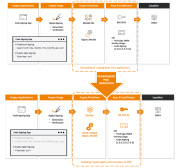
Let us take an example: e.g. an invoice generation application that
a) keeps customer data encrypted at rest,
b) generates e-invoices in the EN 16931 semantic standard,
c) seals them twice using a XAdES enveloped seal on the UBL XML invoice and a PAdES seal on a human-readable PDF,
d) uploads the sealed files into a target folder over an HTTPS channel with mutual TLS authentication.
If we consider the Crypto Agile Architecture above, every operation that needs a secret or a private key runs inside CrystalKey 360 (CK360) through CQL (Crypto Query Language) on the Crypto RESTAPI.The program never stores, generates orreceives a private key, a secret key or a data-encryption key.
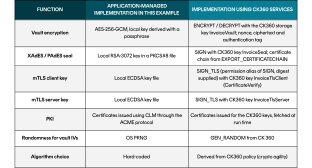
Moving to post-quantum cryptography is then tremendously easier with the crypto agile architecture as it only required a central policy update and key reshape and the new primitives will be inherited to protect the assets in our example:
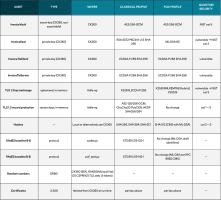
Key material stored locally: none. The CBOM references CK360 keys by name only. The workspace holds ciphertext, public certificates and sealed invoices. The demo and the tests check that no file contains a private key.
The hundred or thousand application problem is ultimately an engineering challenge. Moving direct cryptographic calls behind a governed interface means editing code in hundreds of repositories, each with its own language, framework and owner. AI coding agents change the economics of that work. They must not, however, become a new source of unmanaged cryptography.
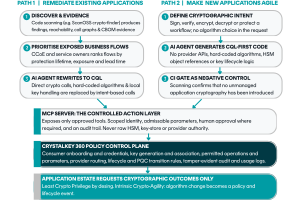
Figure 3. Agentic AI can help remediate existing applications and generates new ones, leveraging CK360 MCP enabled integration.
Existing applications need conversion. A code scanner or discovery product detect the cryptographic assets, builds compliance mapping and exposes weaknesses, vulnerabilities or non compliant items. The team prioritises exposed flows; the agent then rewrites direct cryptographic calls into intent-based CQL calls and requests the required consumer identity, credentials, keys and policy binding.
New applications need prevention. The agent generates CQL-first code from the first commit, with no provider-bound APIs, hard-coded algorithms or application-owned key lifecycle and can extract the CBOM. Using approved integration patterns from the outset can reduce new unmanaged cryptographic dependencies.
KEEP THE AGENT INSIDE THE POLICY
A Model Context Protocol (MCP) server forms the controlled action layer. It exposes only approved operations, under scoped identity, with admissible parameters, human approval where required and an audit trail. It never gives the agent raw HSM, key-store or provider authority. Cryptomathic has demonstrated this pattern with coding agents, an MCP server and CK360 APIs.
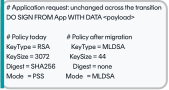
Illustrative CQL request and policy parameters.
The concept has two properties.
Least Crypto Privilege: an application receives only the cryptographic authority its business function needs. It does not choose algorithms, hold unmanaged credentials or decide when keys rotate.
Intrinsic Crypto Agility: a key rotation is straight-forward. An algorithm change, e.g. RSA to ML-DSA, becomes a policy and lifecycle event rather than another round of code changes across the estate.
AI also helps beyond code. It can correlate discovery evidence, draft flow maps, propose test cases and generate runbooks from approved patterns. Human review, deterministic tests and secure handling of code and secrets remain essential.
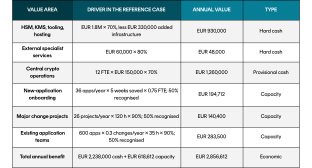
Table 6. Annual run-rate benefit in the ROI calculator’s reference case.
Commission enough governance to support safe decisions, then demonstrate one end-to-end remediation and a reusable pattern. Broader discovery continues throughout.
Appoint an executive sponsors and Cryptographic Centre of Excellence (CCoE) lead. Approve provisional policy and exception authority. Apply the exposure criteria to select three to five flows, covering confidentiality and authenticity. Run targeted discover on those flows and establish the cost baseline.

Work each flow end-to-end with its owners. Select the treatment, approve the first policy profiles and build the first reusable pattern with interoperability, performance, negative and downgrade tests. Pilot agent-assisted remediation.
Run the remediated flow in an authorised environment and release progressively when acceptance criteria pass. Observe actual cryptographic use. Capture closure evidence, compare measured effort, including AI throughput, with the budget and approve the next wave from those results.
Make crypto agility a funded enterprise capability. Use discovery to see the estate, then put the effort where exposure is highest: hand-on remediation of the business flows that matter most, delivered through governed services and accelerated by AI under policy.
PQC then becomes a sequence of governed changes with measurable outcomes. The lasting return is an organisation that can respond to the next cryptographic weakness with less delay, less repeated engineering and evidence that its protection remains effective.

An Enterprise Architecture Guide For Post Quantum Readiness
This guide explains how organisations can prepare for post-quantum cryptography by building the governance and operating model needed to manage cryptographic change.
Crypto-Agility: From Cryptographic Infrastructure to Enterprise Control
This whitepaper explains the operational challenges of cryptographic visibility, ownership and more, while outlining the capabilities needed to support security demands and future PQC migration.
Quantum Secure Key Management: PQShield and Cryptomathic's CrystalKey 360
This guide provides a combined solution to quantum challenges through the strategic technology alliance between PQShield and Cryptomathic, diving into Cryptomathic's CrystalKey 360.