Skip to the main content.

CRYPTO-AGILITY: FROM CRYPTOGRAPHIC INFRASTRUCTURE TO ENTERPRISE CONTROL


DOWNLOAD YOUR COPY

INTRODUCTION

AI is not breaking encryption. It is exposing the weakness around it.

Modern encryption still depends on proven cryptographic design, mature standards, and well-implemented controls. The more immediate risk is operational: exposed secrets, unmanaged certificates, hard-coded algorithms, inconsistent lifecycle processes, undocumented dependencies, and unclear ownership. These weaknesses have always mattered. AI changes the pace at which they can be found, exploited, and scaled.

The UK National Cyber Security Centre has assessed that AI will almost certainly increase the volume and impact of cyber attacks, with particular uplift in reconnaissance and social engineering. It also notes that AI lowers the barrier for less-skilled actors to carry out access and information-gathering operations.

For enterprises that rely on cryptography to protect payments, digital identity, signing, software integrity, cloud services, trust services, and sensitive data, this changes the nature of the risk. The question is no longer only whether strong algorithms are in use. The question is whether cryptography can be seen, governed, changed, evidenced, and trusted across the business.

That is why crypto-agility has become a strategic requirement. It helps organizations reduce operational exposure today while preparing for foundational cryptographic change tomorrow.

CRYPTOGRAPHIC RISK IS NOW AN OPERATING MODEL PROBLEM

Cryptography underpins modern digital business. It protects payment systems, transaction signing, software integrity, digital identity, cloud services, data protection, HSM-backed trust services, regulatory compliance, and secure application delivery.  In many organizations, however, cryptography is still operated as fragmented infrastructure.

Different teams manage different tools. Applications rely on undocumented algorithms. Certificates and keys may be owned locally, rotated inconsistently, or only partially inventoried. Cloud services, payment environments, trust services, application teams, and compliance functions often work with separate processes and evidence models.

This creates a dangerous imbalance. Cryptography is everywhere, but cryptographic control is incomplete.

A strong algorithm cannot compensate for an exposed private key. A secure HSM does not solve unclear ownership. A well-designed certificate architecture cannot protect the business if renewal, rotation, and exception handling depend on inconsistent local processes. The most pressing cryptographic risk for many enterprises is therefore not weak mathematics. It is weak management. Poor visibility makes risk difficult to quantify. Unclear ownership slows remediation. Manual lifecycle processes increase cost and inconsistency. Limited evidence makes audits harder. Fragmented infrastructure increases the complexity of modernization.

AI increases the urgency because it puts more pressure on these operational weaknesses.

AI INCREASES PRESSURE ON WEAK CRYPTOGRAPHIC OPERATIONS 

AI does not need to break encryption to increase cryptographic risk. It can help attackers work faster around the edges of cryptography: reconnaissance, social engineering, vulnerability research, phishing, credential theft, data analysis, and target identification. The NCSC assessment describes capability uplift in reconnaissance, phishing, coding, exfiltration, and the analysis of stolen data, while noting that more advanced offensive uses still depend on expertise, resources, and quality data.

For security leaders, this creates a practical set of questions:


Can we identify where cryptography is used?

Can we see which systems depend on which algorithms, keys, certificates, libraries, HSMs, cloud key stores, and trust services?


Can we tell who owns each dependency?


Can we change cryptography without disrupting critical services?

Can we identify non-compliant, expired, exposed, duplicated, or undocumented cryptographic assets?


Can we prove what was changed, who approved it, and what risk remains?

These are not abstract security questions. They are governance questions, operational questions, audit questions, and resilience questions.

Organizations most exposed to AI-enabled pressure may not be the ones using the weakest cryptography. They may be the ones that cannot see, govern, or change cryptography quickly enough when operational weakness becomes business impact.

QUANTUM RAISES THE COST OF DELAY

AI increases pressure on today’s cryptographic operations. Quantum computing creates tomorrow’s foundational challenge.

The quantum threat is different because it will require organizations to transition away from cryptographic foundations that are deeply embedded across applications, infrastructure, devices, protocols, payment systems, identity services, and third-party ecosystems.

NIST finalized its first three post-quantum cryptography standards in August 2024 and encouraged system administrators to begin transitioning because full integration will take time. Those standards include FIPS 203 for general encryption, and FIPS 204 and FIPS 205 for digital signatures.

The NSA has also stated that a cryptanalytically relevant quantum computer would have the potential to break today’s public-key systems, and that organizations should plan, prepare, and budget for a transition to quantum-resistant algorithms.

This makes post-quantum cryptography more than an algorithm decision. For enterprises, it is an operating model challenge. The issue is not only which quantum-resistant algorithms to select. It is knowing where vulnerable cryptography exists, which systems depend on it, which owners must act, which business services are affected, how change can be phased, and how progress can be evidenced.

Organizations that delay preparation may eventually face compressed, expensive, and disruptive migration programs. They may discover too late that they lack a complete cryptographic inventory, consistent lifecycle processes, clear ownership, or a controlled path to change.

Crypto-agility reduces that future disruption by building the required operating capabilities before the transition becomes urgent.

WHAT CRYPTO-AGILITY REALLY MEANS

Crypto-agility is the enterprise capability to adapt cryptographic controls, implementations, algorithms, keys, certificates, and dependencies safely, consistently, and at scale.

It is often discussed as a cybersecurity concept, but its value is broader. Crypto-agility supports enterprise resilience, operational efficiency, compliance confidence, and technology modernization.

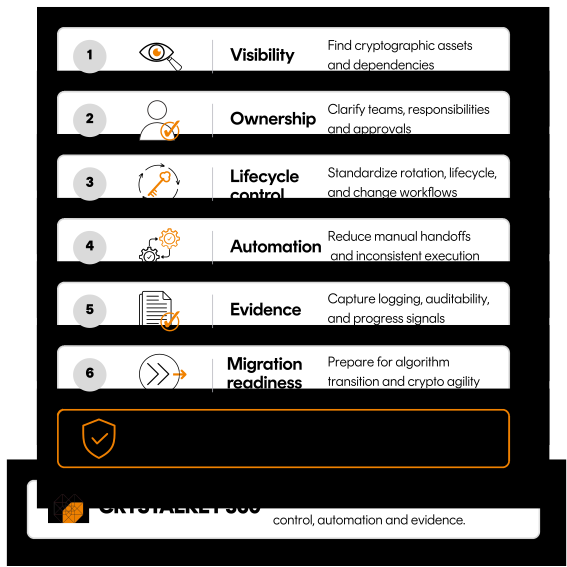
A crypto-agile operating model depends on six capabilities.

VISIBILITY

Organizations need to know where cryptography exists and how it is used. This includes applications, APIs, cloud services, HSMs, trust services, payment systems, data protection services, certificates, keys, algorithms, protocols, parameters, and third-party dependencies.

polygon-23-1

OWNERSHIP

Critical cryptographic assets need accountable owners, business context, approval paths, and remediation responsibility. Without ownership, cryptographic risk becomes distributed but unmanaged.

polygon-23-1

LIFECYCLE CONTROL

Keys, certificates, algorithms, and cryptographic services need standardized processes for issuance, renewal, rotation, expiry, policy change, exception handling, and retirement.

polygon-23-1

AUTOMATION

Manual cryptographic operations do not scale. Automation reduces human error, shortens remediation cycles, improves consistency, and lowers operational cost across teams, platforms, clouds, and regions.

polygon-23-1

EVIDENCE

Crypto-agility must produce audit trails, ownership records, policy history, approval evidence, lifecycle logs, exception records, and remediation reporting. Evidence turns cryptographic governance into something measurable and defensible.

polygon-23-1

MIGRATION READINESS

Organizations need the ability to execute cryptographic transition in a controlled way. That means reducing dependency on hard-coded cryptography, decoupling cryptographic services from applications, and preparing for phased post-quantum adoption.

polygon-23-1

Together, these capabilities shift cryptography from a hidden technical dependency to a managed enterprise control.
CK360 Graphics


FROM FRAGMENTED INFRASTRUCTURE TO GOVERNED CRYPTOGRAPHIC SERVICES

The strongest opportunity is not simply to manage cryptography better. It is to change how cryptography is delivered.

Many organizations still treat cryptography as fragmented infrastructure. Different teams operate different tools. Applications consume cryptographic functions inconsistently. Policies are implemented unevenly. Evidence is collected manually. Lifecycle control depends on local process maturity. This model creates friction for the business. It slows application onboarding. It complicates audits. It increases operational cost. It creates inconsistent controls. It makes future migration harder.

A better model is to establish cryptography as a governed enterprise service layer.

In this model, a central control layer provides governance, policy, lifecycle automation, evidence capture, and operational visibility across existing infrastructure. It can integrate with HSMs, cloud key stores, payment environments, trust services, applications, signing services, certificate lifecycle processes, and data protection workflows.

The value is not wholesale replacement. The value is control. Organizations can modernize gradually, reduce fragmentation, and create a consistent operating model without disrupting every underlying system at once.

Applications, partners, and business units should not have to design and manage cryptographic controls in isolation. They should be able to consume approved cryptographic services through a repeatable enterprise model.

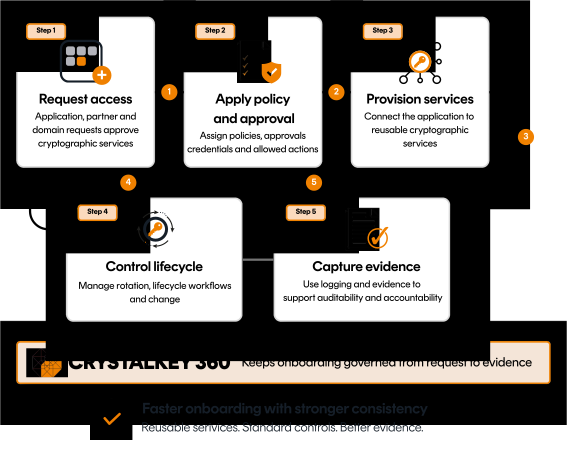
That model creates a structured path:

1) Request access to approved cryptographic services.
2) Apply policy, approval, credentials, and allowed actions consistently.
3) Provision reusable cryptographic services without redesigning infrastructure for every application.
4) Control renewal, rotation, lifecycle workflows, and change processes through a governed model.
5) Capture logs, audit trails, ownership records, and accountability evidence automatically.

This makes cryptography easier to consume, easier to govern, and easier to scale.

For the business, the benefits are direct: faster onboarding, lower operational friction, stronger audit readiness, clearer ownership, more consistent policy enforcement, reduced dependency risk, and a more scalable foundation for post-quantum migration. Cryptography must evolve from fragmented infrastructure into governed cryptographic services.
CK360 Graphics-1


PREPARING FOR POST-QUANTUM MIGRATION

The first step toward post-quantum readiness is not algorithm replacement. It is cryptographic visibility.

Organizations need to know where public-key cryptography is used, where sensitive data is protected, which systems rely on vulnerable algorithms, which business services would be affected by migration, and which vendors or third parties introduce additional dependencies. Only then can they prioritize.

Not every system carries the same risk. Long-lived sensitive data, transaction integrity, identity infrastructure, payment environments, code signing, root trust, and high-assurance services may require earlier planning than lower-risk or short-lived use cases.

A crypto-agile operating model supports phased migration. By decoupling cryptography from applications, organizations can change algorithms and mechanisms without redesigning every business process. A code-signing application, for example, may eventually move from classical signing mechanisms to post-quantum alternatives while preserving the broader governance process, service model, and accountability structure.

That is how organizations move from reactive replacement to controlled modernization.

POST QUANTUM ICON

THE EXECUTIVE MANDATE


AI and quantum computing are often discussed as technology trends. Their impact on cryptography is more strategic.

AI increases the likelihood that unmanaged operational weaknesses will be found and exploited. Quantum computing increases the likelihood that cryptographic foundations will need to change. Together, they create a clear executive mandate.

Cryptography must be visible. Cryptography must be governed. Cryptography must be changeable. Cryptography must be auditable. Cryptography must support business resilience.

This requires leadership across security, infrastructure, application development, architecture, risk, compliance, and business ownership. Crypto-agility is not a side project for cryptography specialists. It is a strategic capability for any organization that depends on digital trust.

The next phase of cryptographic risk will not be defined only by stronger algorithms. It will be defined by whether organizations can operate cryptography as a managed enterprise capability.

The first step is not replacing algorithms. It is gaining control over the cryptography the business already depends on.

cryptomathic_logo_orange-06

BUILD THE OPERATING MODEL BEFORE CRYPTOGRAPHIC CHANGE BECOMES URGENT


Post-quantum migration, AI-enabled threat pressure, and rising audit expectations all point to the same requirement: organizations need clearer visibility, ownership, lifecycle control, automation, and evidence across their cryptographic estate.  

Explore how Cryptomathic supports PQC readiness and crypto-agility for regulated organizations.

TALK TO AN EXPERT TODAY