HSM refresh and consolidation
Use your next HSM refresh to simplify your cryptographic estate
Before committing to replacement hardware, assess where shared cryptographic services could reduce duplicated infrastructure, simplify operations and make future changes easier.
Request an HSM refresh assessmentReview the estate before replacing the hardware
Your HSM estate may have grown around individual applications, projects and security requirements. A refresh gives you an opportunity to review those infrastructure, integration and lifecycle decisions before committing to another investment cycle.
- Which workloads need dedicated infrastructure?
- Where could applications share cryptographic services?
- What would each option cost to introduce and operate?
Like-for-like replacement
Refresh with shared services
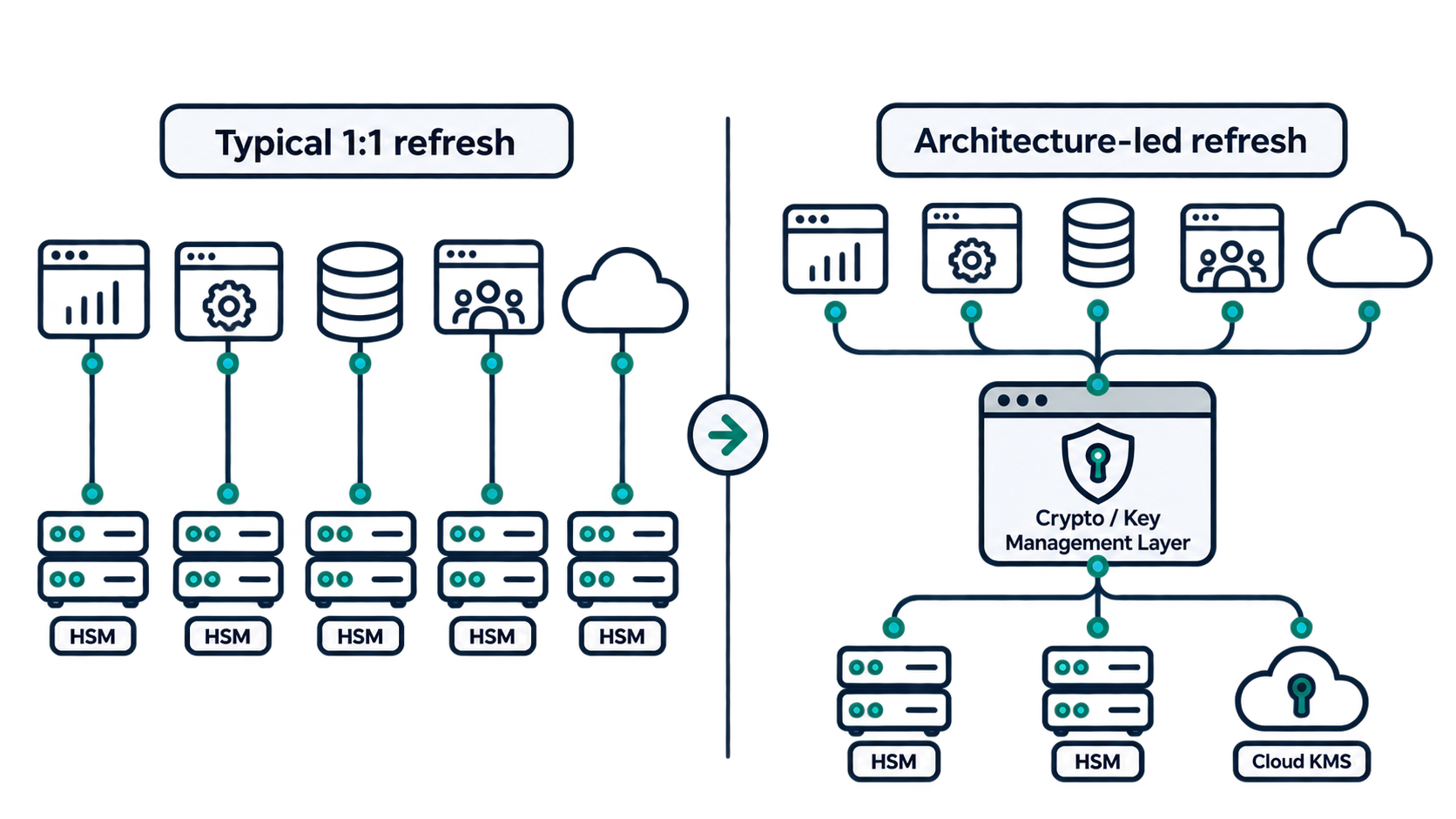
Like-for-like replacement
Applications → separate integrations → dedicated HSM deployments.
Refresh with shared services
Integrated applications → shared cryptographic service and control layer → supported HSM infrastructure or supported cloud KMS, according to workload requirements.
What your next refresh could improve
Reduce duplicated infrastructure
Identify where shared capacity could replace separate deployments across your estate. Assess utilisation and workload requirements together. Retain dedicated infrastructure where isolation, resilience, performance or security boundaries require it, rather than treating consolidation as a target for every workload.
Simplify cryptographic operations
Standardise policy and key lifecycle workflows across supported environments. Reduce repeated administration and make application onboarding more consistent. Assess the processes, approvals and service ownership required to establish these workflows and maintain them as your cryptographic estate evolves.
Make future changes easier
Evaluate where a common service layer could reduce repeated application work during upgrades, scaling or replacement. Compare the initial integration effort with the compatibility checks, testing and rollout work your teams would still need when underlying infrastructure changes.
How CrystalKey 360 fits
CrystalKey 360 provides a common cryptographic service and control layer across supported HSMs and key stores.
- Integrated applications consume cryptographic services through a common layer.
- Teams centrally manage access, policy and key lifecycle operations.
- Underlying infrastructure can evolve within the capabilities and compatibility of the supported deployment.
For applications integrated through CK360’s Crypto Service, this layer can reduce coupling to the underlying HSM platform. Initial integration, supported interfaces and platform compatibility still need to be assessed.
Remote cryptographic operations and key distribution are distinct integration patterns; your architecture must identify which each application requires.
Illustrative architecture. Integration and infrastructure choices depend on supported deployment capabilities.
.png)
Compare the full cost of your HSM refresh
Hardware pricing is one part of the business case. Compare initial migration costs and recurring operating effort over the same planning period.
Application integration and testing
Include provider updates, configuration changes, compatibility checks and regression testing across cryptography and application teams. Separate the initial work of connecting to the replacement architecture from integration and testing required for later changes.
- Which interfaces and providers need to change?
- Which tests must each application team repeat?
- What integration work would future replacements still require?
Key provisioning and lifecycle administration
Assess key creation, distribution, rotation, backup and retirement, including approvals, key ceremonies and audit evidence. Distinguish the effort to establish consistent workflows from the administration needed to operate them.
- Which tasks are manual or specific to individual deployments?
- What approvals and audit evidence must each workflow retain?
- What ongoing ownership and maintenance would automation need?
Production, test and disaster recovery capacity
Size the full estate for peak demand, failover, maintenance windows and expected growth. Compare acquisition and deployment costs with the recurring cost of maintaining production, test and disaster recovery capacity.
- What capacity is required during failure or maintenance?
- How much capacity must remain available for testing?
- Where could utilisation improve while meeting workload requirements?
Support, maintenance and operational effort
Include firmware updates, monitoring, incident response, training and coordination alongside support contracts. Separate transition and training effort from the people and processes needed to run the target estate.
- Which teams own maintenance and incident response?
- What specialist skills and support coverage are required?
- How will recurring operational effort change?
The cost of introducing and running a shared service layer
Include licensing, deployment, integration and training, plus monitoring, resilience and service ownership. Account separately for any parallel operation during migration and the recurring cost of running the shared layer.
- What implementation and licensing costs apply?
- How long must old and new environments run in parallel?
- What resources are needed for ongoing service ownership?
The effort required for subsequent infrastructure changes
Evaluate the next hardware replacement, vendor change or algorithm transition. A shared layer can reduce direct application dependencies, but compatibility checks, testing and rollout still require resources.
- Which application dependencies remain tied to specific HSMs?
- What compatibility and testing work would the next change require?
- How would the change be rolled out within operational constraints?

John Smith
Director of Marketing
Fashion axe raw denim art party quinoa banh mi single-origin coffee. Flannel unicorn palo santo, seitan pabst art party knausgaard brooklyn meh cardigan vinyl tote bag thundercats glossier.
Start with an HSM refresh assessment
A focused discussion reviews your existing estate and planned replacement.
What the assessment reviews
- HSM platforms and generations
- Applications consuming cryptographic services
- Current interfaces and integration dependencies
- Capacity and utilisation
- Resilience, isolation and security requirements
- Key lifecycle workflows
- Replacement deadlines and migration constraints
What the discussion helps establish
Identify where shared services merit further evaluation, which workloads should retain dedicated infrastructure, and what migration constraints need to shape the refresh plan.
Assess whether CK360 belongs in your refresh project before choosing the target architecture.
Request an HSM refresh assessmentQuestions to resolve before you commit
Can we consolidate every HSM workload?
No. Consolidation depends on the workload. Security boundaries, availability, performance and application requirements may justify dedicated infrastructure. Review those requirements before deciding which workloads could share cryptographic services.
Will applications need to change?
They may need to change, depending on their current interfaces and the target architecture. Distinguish the initial integration and testing effort from any potential reduction in repeated application work during future infrastructure changes.
Can existing keys move to the new infrastructure?
Not every key can be moved. Portability depends on the source and destination platforms, key attributes, export restrictions and supported migration mechanisms. Assess these requirements before selecting the target architecture.
Can we change architecture without delaying the replacement?
Where appropriate, immediate hardware replacement and longer-term service changes can be phased. The replacement deadline must shape the plan, together with integration dependencies, testing requirements and supported migration options.