SECURING THE EUROPEAN DIGITAL IDENTITY WALLET WITH APPS
Implementing best practice security for a high-risk asset

THE EUROPEAN DIGITAL IDENTITY WALLET
The European Commission promotes the European Digital Identity wallet (EUDI wallet) as part of its effort to digitize the economy and help foster trust services. In practice this means that from the end of 2023 each EU Member State must offer a mobile-based wallet to their citizens, residents and businesses to identify and authenticate online. The scope of this app has been initially described in the Outline of the European Digital Identity Architecture and Reference Framework (The Outline)3, now superseded by The Common Union Toolbox for a Coordinated Approach Towards a European Digital Identity Framework4.
The Toolbox, adopted by the eIDAS Expert Group in January 2023, includes The European Digital Wallet Architecture and Reference Framework (ARF). While still work in progress and non- mandatory, it is expected to be replaced by the European Digital Identify Framework Regulation which willbe mandatory.
Through the EUDI wallet, which is part ofthe elDAS 2.0 proposal5, users should be able to securely store and selectively share in an app, locally or remotely, on request and under their sole control, identification data based on their national electronic IDs (elDs), as well as other attestations of attributes such as digital travel credentials (ePassports), driver's licenses, university diplomas, and also personal information including medical records or bank account details. The wallet should also allow them to access a variety of online services and sign documents with qualified electronic signatures and seals (QES). More broadly, the EUDI Wallet is a means to store and share digital assets and ensure trust through verified identities, reliable user authentication and legally binding signatures.
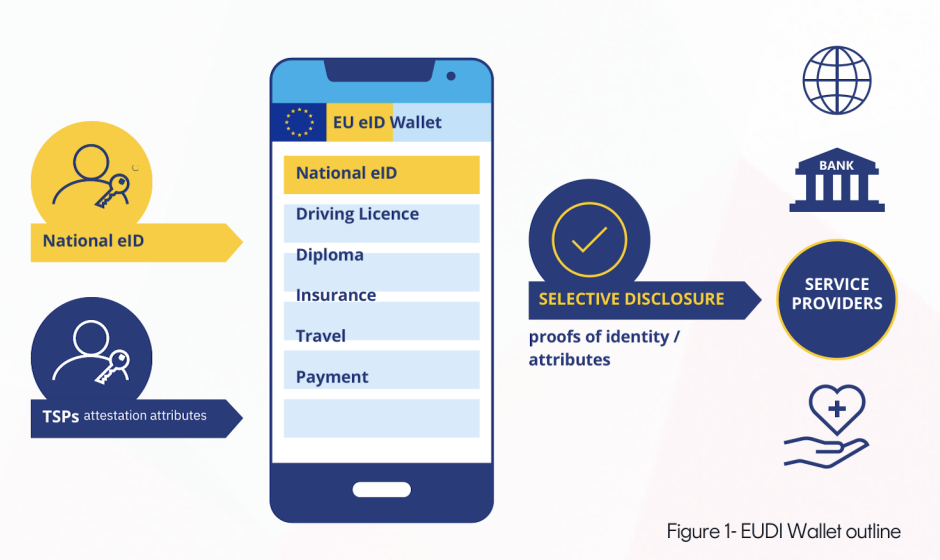
However, shifting to a mobile device creates security challenges due to a complex threat model and a significant increase in attack vectors due to the change in form factor, increase in features and expanded eco-system. The EUDI wallet must offer a sufficient level of protection against attacks from adjacent malware that may have been installed by naïve users and against professional and dedicated attacks on an emulated or rooted platform. Attacks could also target the communication channel between the EUDI wallet App and the back-end services or the back-end itself. Exploiting vulnerabilities in the ecosystem could result in forged identities or false claim assertions, including identity theft and data leaks.
Issuance of the EUDI wallet is up to each Member State, but eventually the EUDI wallet is to be used across Member States. The proposal for amendment of the elDAS regulation foresees that the issuer of the EUDI wallet may be the Member State itself, directly or through a mandate, or an independent party recognized by a Member State6. In all cases, issuing an EUDI wallet comes with a huge liability and a high risk for reputational damage, both for the issuer and the Member State. Upon breakage or compromise of an EUDI wallet, the issuing Member State shall, without delay, suspend the issuance and revoke the validity of the European Digital Identity wallet and inform the other Member States and the Commission accordingly. One can easily anticipate the media coverage in hypothetical cases such as:
- Terrorists break into the Belgian identity wallet and present seemingly valid travel documents at Charles de Gaulle airport.
- A Swedish minister presents a counterfeited diploma using her EUDI wallet during the due diligence process prior to her official appointment.
- EUDI wallet vulnerability is exploited by an unknown attacker resulting in the leakage of confidential data for 3 million Danish citizens.
- Hacktivists exploit the Spanish EUDI wallet to obtain social health benefits for 3000 migrants.
The European Commission intends to release an open-source software development kit (SDK) for the EUDI wallet to help ensure interoperability and foster usage. Nonetheless, the reliability for the security of the wallet remains to the issuer and the issuing country.
While the EUDI wallet will implement a number of security features which may include an embedded crypto interface and interfaces a Trusted Execution Environment (TEE) and native Secure Elements (SE), the SDK will not be in a position to mitigate security risks such as reverse engineering, nor will it provide strong device and assurance. EUDI wallet issuers will need to further harden the app and run penetration tests to pass certification.
CORE FUNCTIONALITY OF THE EUDI WALLET
The EUDI wallet must be able to provide mutual identification and authentication between the wallet and external entities. It must be able to perform electronic identification of the EUDl wallet user, and store and manage digital assets and provide qualified electronic attestation of attributes (QEAA) and electronic attestation of attributes (EAA). It must be able to request and obtain such QEAA and EAA from providers, protect them against counterfeiting and unintended information disclosure, and share person identification data (PID) and QEAA and EAA selectively with relying parties, both electronically and visually, with signatures verifying the authenticity of the documents. The PID and attribute presentation must also function offline, without network access.
The EUDI wallet must implement (access to) all cryptographic functions needed for the above functionalities and must provision qualified and non-qualified electronic signatures and seals either locally on the device or using a remote Qualified Signature Creation Device (QSCD).
The EUDI wallet will be able to interact with relying parties, for example citizen portals, banks, online platforms and airports, through its external interface to request attestations with mutual authentication.
While the elDAS 2.0 proposal foresees that the EUDI wallet storage can be local or remote, i.e. located on a device the user holds or in a cloud-based infrastructure, the requirement for offline sharing of identifying data and attested attributes means that, either way, some minimum on-device storage is required that must be adequately protected.
The ambitious scope of the EUDI wallet presents a significant attack surface and requires careful planning in order to deploy a secure solution.
Figure 2 depicts the functionalities of the core EUDI wallet and its interfaces with external entities

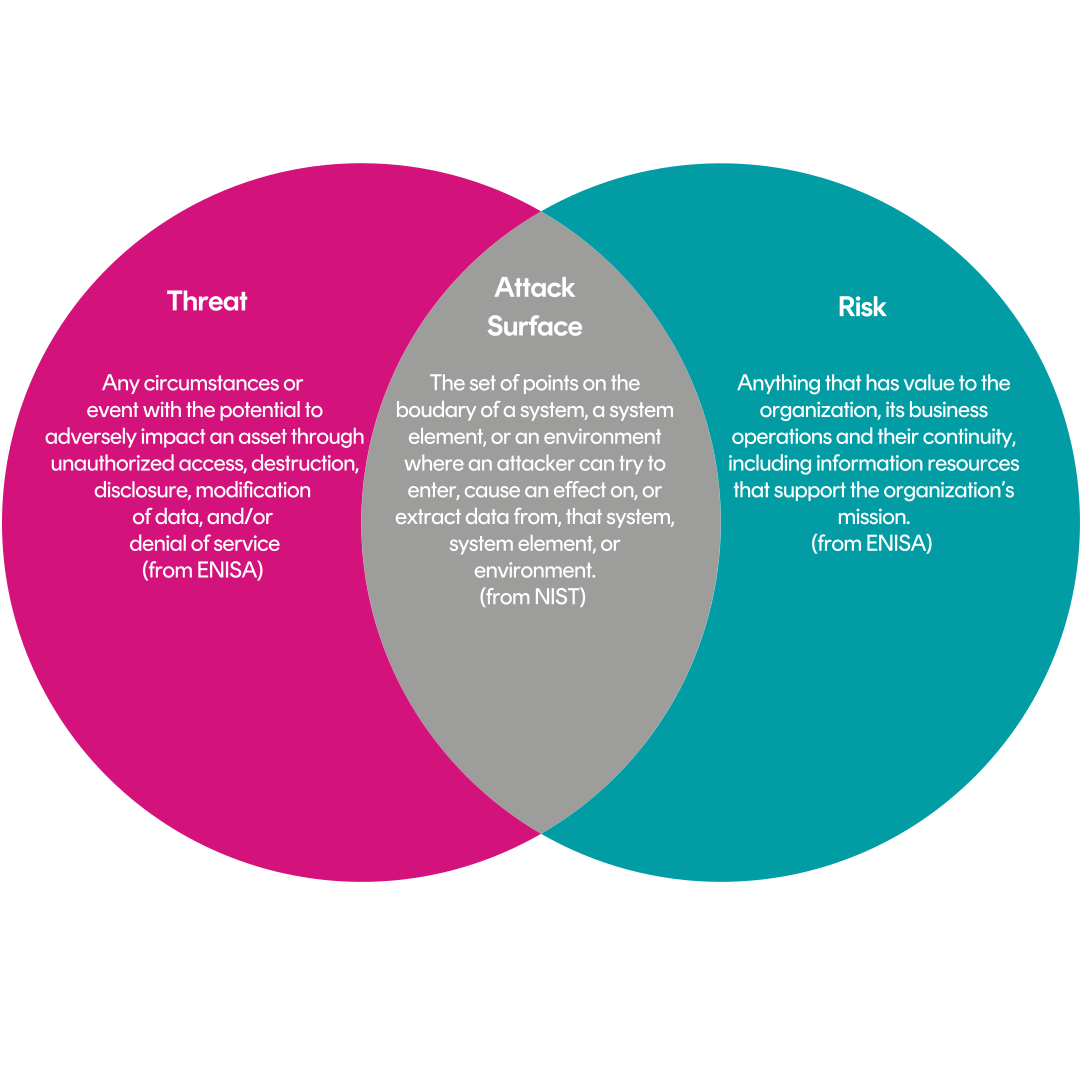
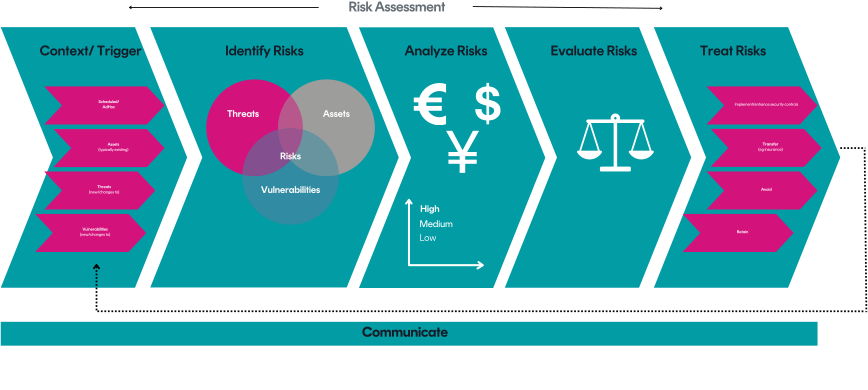 Figure 5 - Representative Risk Management Process
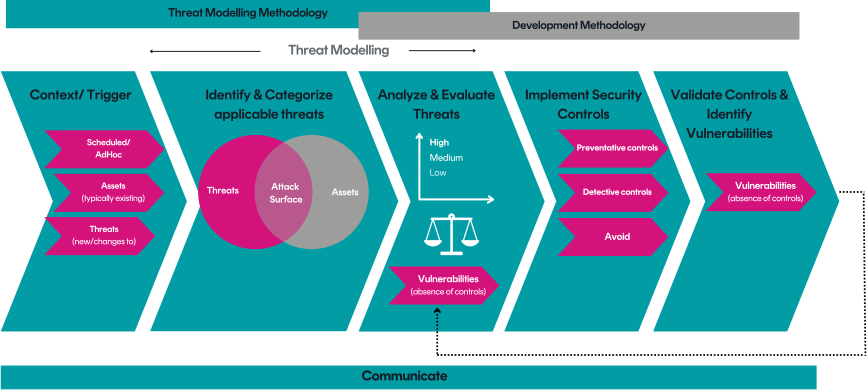 Figure 6: Representative Risk Management Process
THREATS TO THE EUDI WALLET
Threat Landscape and Actors
In its latest annual Threat Landscape Report12, ENISA provides a thorough analysis on the status of cybersecurity threat landscape, including identification of top threats, major trends, threat actors and attack techniques, impact and motivation analysis as well as relevant mitigation measures. The report states that threat actors are increasing their capabilities, having frequent access to previously unknown (0-day) exploits, developing their hacker-as-a-service business model and developing novel and hybrid threats.
Threats to the EUDI wallet will come from multiple diverse sources across this entire landscape, all with varying motives. This paper will align with the four classifications of threat actors defined by ENISA: State sponsored actors; hacktivists; cybercrime actors; and hacker for hire actors.
Modelling Threats to the EUDI Wallet
When modelling threats, there are several techniques from which to choose depending on the modelling perspective as well as the required level of sophistication.
Organizations will likely have their own approaches but this example will use the Microsoft developed STRIDE13 model to categorize different types of threats as it takes an asset-centric approach to describing them and is a relatively straightforward model to apply.
The name itself is a mnemonic where each letter corresponds to one of the six threat categories as detailed in the following table.
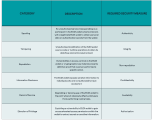
Figure 7: STRIDE Threat Model by Microsoft
It is worth noting that the EUDI wallet must work offline and must therefore store sensitive data like keys, and personal identity documents.
This requires that documents, cryptographic keys and other private information be present on a mobile platform which may be exposed to loss, hardware failures, malware, hackers and thieves. Protecting this sensitive data against copying and viewing by unauthorized parties, while at the same time providing controlled access to authorized parties, is paramount.
The mobile platforms (iOS and Android) are owned by US commercial companies who are not subject to EU legislation. The mobile hardware is mostly manufactured in the Far East and mainland China, therefore, relying solely on the hardware and OS platform's security measures may be risky for vital identification documents like passports and driver's licenses.
The threat actors will then seek vulnerabilities in:
- The people that support the EUDI wallet ecosystem as well as the EU citizens that use the wallet.
- The processes associated with the scheme.
- The technologies with which the EUDI wallets have been implemented and the methods used to implement them.
Broadly speaking, when considering the EUDI wallet itself, there are two attack vectors:
Attacks against the mobile app itself
This is inherent to mobile apps that are published to the Apple App Store, Google Play store and such like to be installed on unmanaged devices. This opens the EUDI wallet up to countless attacks via the app or the device itself, such as using reverse engineering tools, exploiting device memory, altering the user interface or creating similar apps to confuse the user. Mobile app developers can leverage the security features of the OS and run pen tests themselves, but this does not provide a robust enough framework to operate an EUDI wallet.
Attacks against APIs and communication channels
Such attacks will focus on the interfaces between the EUDI wallet and the participants in the wallet scheme primarily to expose personal identity data and personal attributes. Additional attacks could focus on attempting to obtain application logic by probing the interfaces.
Threat agents can be considered an extension to the definition of threat actors and are typically tools, techniques and assets used to exploit vulnerabilities. They will be used in an attempt to exploit the attack surface of the EUDI wallet via one of the two attack vectors.
Examples of threat agents are numerous and include:
- Lost/stolen EUDI wallets in the hands of a threat actor.
- Malware installed on the device which can interact with the EUDI wallet in a malicious manner to log user credentials, output, or probe the app to act in an unintended manner. This includes malicious overlays and screen casting tools.
- Jailbroken/rooted devices.
- A jailbroken device offers less OS guarantees and a rooted device.
- Repackaged apps on the mobile device hosting the wallet that interact with the wallet.
- Mobile apps that incorrectly implement security mechanisms the underlying mobile app platform (e.g. iOS, Android).
- A compromised or monitored network that allows eavesdropping or altered network communications.
- Development and test tools that can interact with the mobile app at a low level to gain a detailed understanding of how the app's security mechanisms work to obtain sensitive information contained within it or change the way in which the app operates.
- Poor code quality can lead to the discovery of vulnerabilities that the attacker can exploit.
Without device and API assurance, it is not sound to launch a EUDI wallet.
SELECTING A MOBILE APP SECURITY SOLUTION
Terminology
RASP vs App Shielding vs In-App Protection
The importance of implementing appropriate security mechanisms within the EUDI wallet is clear but it can be confusing to determine exactly what protections are needed when researching vendors and solutions.As a starting point, Gartner defines three categories of mobile app security solutions:
Runtime application self-protection (RASP)
A security technology that is built or linked into an application or application runtime environment that can control application execution while detecting and preventing real-time attacks.17
Application shielding
This refers to protection capabilities that are implemented directly within the application, rather than inline or on the hosting system, to prevent and detect attacks such as tampering and reverse engineering. Application shielding can be used for any type of application, but there is currently a particular focus on mobile apps.18
In-App protection
These are security solutions implemented within the application (instead of the network or the operating system, for example) to make the application more resistant to attacks such as malicious data exfiltration, intrusion, tampering, and reverse engineering.19
The Two Types of Mobile App Security Solutions
Solutions classified as providing RASP, app shielding or in-app protection all offer safeguard against reverse engineering and tampering. However, they all fall into one of two key categories:
i. lt secures the app after development: Once development is complete and the app is tested and functional, it is submitted to a service to have software protection mechanisms added to the final code and have its structure altered to make it difficult to reverse engineer and tamper. During this process, configuration settings determine which protections to enable.
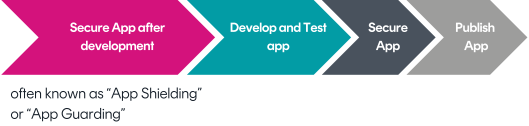
Figure 8: Mobile App security solution as a service
Solutions described with terms like 'app shielding', 'app guarding' or similar tend to offer this service. This solution is relatively easy to implement.
ii. It includes a toolkit to secure the app during development: At the outset of the development, a software development kit (SDK) is incorporated to the development environment. The SDK is essentially a suite of security tools that prevent reverse engineering and tampering of the app.
The developer can then focus on developing the functional requirements of the mobile app while leaving the specialist and security-critical parts to the SDK.
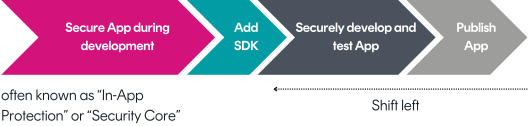 Figure 9: Mobile App security solution includes a toolkit
Such solutions are aligned with the 'shift left' approach whereby security is a central design consideration at an earlier stage in the development lifecycle rather than an afterthought. Solutions described with terms like 'in-app protection', 'security core' or similar tend to offer an SDK. They tend to offer increased security coverage, flexibly tailored the specific functionality of the app.
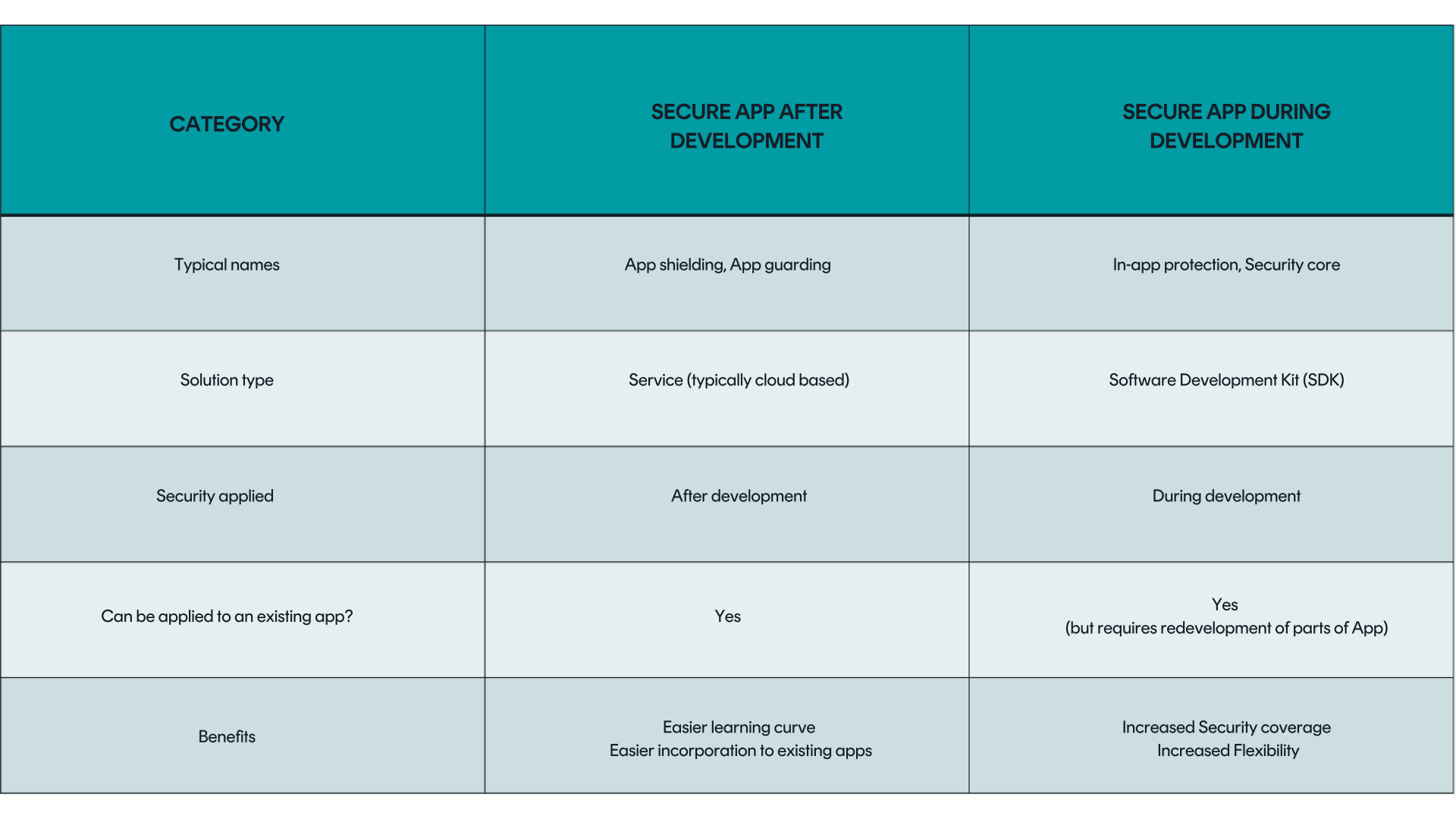
Figure 10: Comparison of Two Types of Mobile App Security Solutions
What to Look for in Your Mobile App Security Solution
Having modelled the threats against your EUDI wallet mobile app and using the STRIDE model (Section 6.2) for this example, you will start to see a pattern emerging for required security measures.
For the threats classified as Spoofing you will require a security measure that provides authenticity. Such an authentication mechanism requires a tamper-resistant environment (integrity protected) in which to run, as well as access to secrets that are protected against Information disclosure.
For threats classified as Repudiation you will require a nonrepudiation countermeasure. Such a security measure requires that the information is integrity protected and authenticated (using public key cryptography). Again, this points to a security measure that runs in a tamper-resistant and confidentialityprotected environment.
Threats classified as Elevation of privilege will require the development of appropriate authorization mechanisms. Again, to be robust, they will need to be protected from tampering and information disclosure.
There are few threats that can be categorized as Denial of service for the mobile app itself, however a standard countermeasure is to ensure connections are appropriately authenticated. Again, this requires mechanisms that are protected from tampering and information disclosure.
Thus, the foundation of secure mobile app development is mechanisms that protect the integrity and confidentiality of the app and its contents, essentially protecting against Information disclosure (using anti-reverse engineering security measures) and Tampering (using anti-tampering security measures).
Therefore, you should choose a mobile app security solution that has comprehensive coverage of security measures against Information disclosure and Tampering, both while the app is running (dynamic) or not running (static). Using such a mobile app security solution as the foundation, the EUDI wallet developer can feel confident in implementing the other security measures directly into the app.
The following table describes the security measures to look for when selecting your mobile app security solution and the rationale for each.
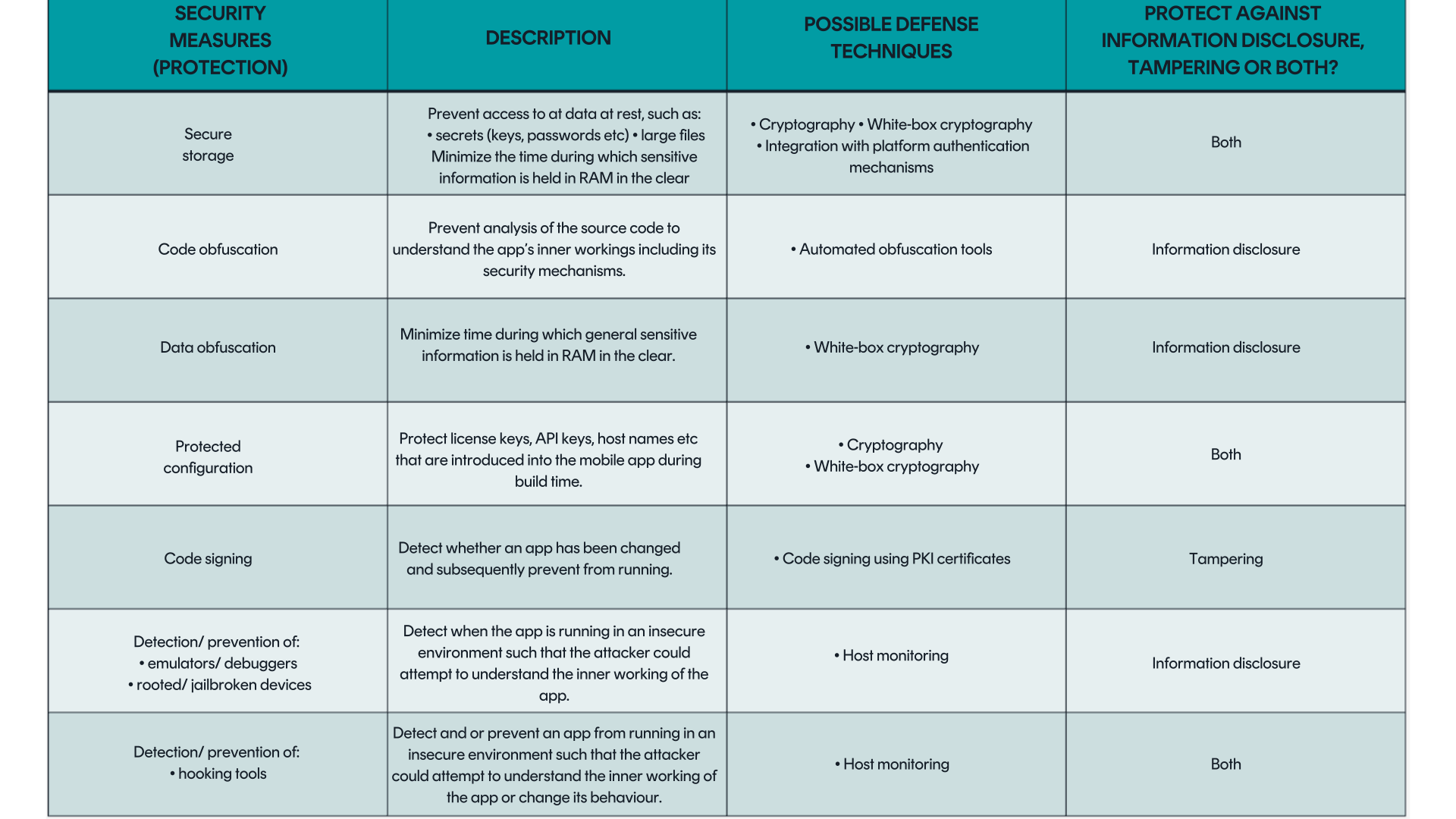 Figure 11: Security Measures Relevant for Selecting a Mobile App Security Solution
 Figure 12: (Continuation) Security Measures Relevant for Selecting a Mobile App Security Solution
Certain of the security measures in Figures 11 & 12 can be classified as protection against information disclosure, against tampering, or against both. Further, security measures can provide protection while the app is running (dynamic), dormant (static), or both. The following diagram depicts which security measures from Figure 13 fall into which classification.
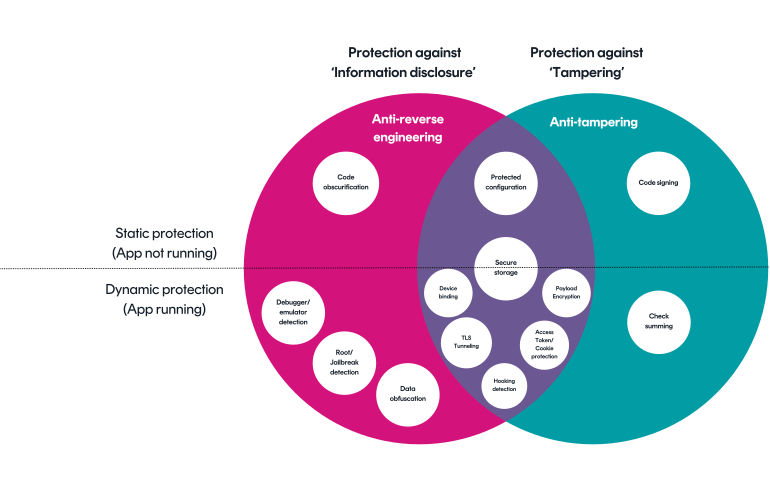 Figure 13: Classification of security measures
INTRODUCING THE CRYPTOMATHIC MOBILE APP SECURITY CORE
Cryptomathic Mobile App Security Core (MASC)20 is a security software development kit (SDK) for the EUDI wallet, elD apps, mobile banking apps etc., comprising of multiple layers of mutually reinforcing mobile app security components that are provided with a simple, easy-to-use API. It enables app developers to focus on developing excellent business applications while leaving the specialist security critical parts to MASC.
Protecting applications in a hostile environment is a cat-and-mouse game with attackers. Released over 10 years ago, MASC stays ahead by providing an evolutionary security framework through regular defense mechanism refinement and updates and randomized protections, disrupting the business model of fraudsters attempting to exploit the protection of targets long-term. MASC features multiple layers of security, including: libraries for security protocols, TLS authentication with pinned certificates and third-party libraries integrated for malware detection and device fingerprinting.
MASC offers technology for reverse engineering resistance, jailbreak / root detection and secure configuration and operation of generic mobile apps. To provide 360-degree protection, there are additional mechanisms for obfuscation, anti-tamper and anti-debug, as well as a reporting scheme allowing for live monitoring and dynamic analysis of the current threat landscape. A central part of MASC is the ability to provide the application with secure storage and independent cryptographic functions. The storage builds on and extends key stores offered by the device or OS and can be used to protect critical cryptographic keys, for instance application keys or communication keys for entities like the backend services
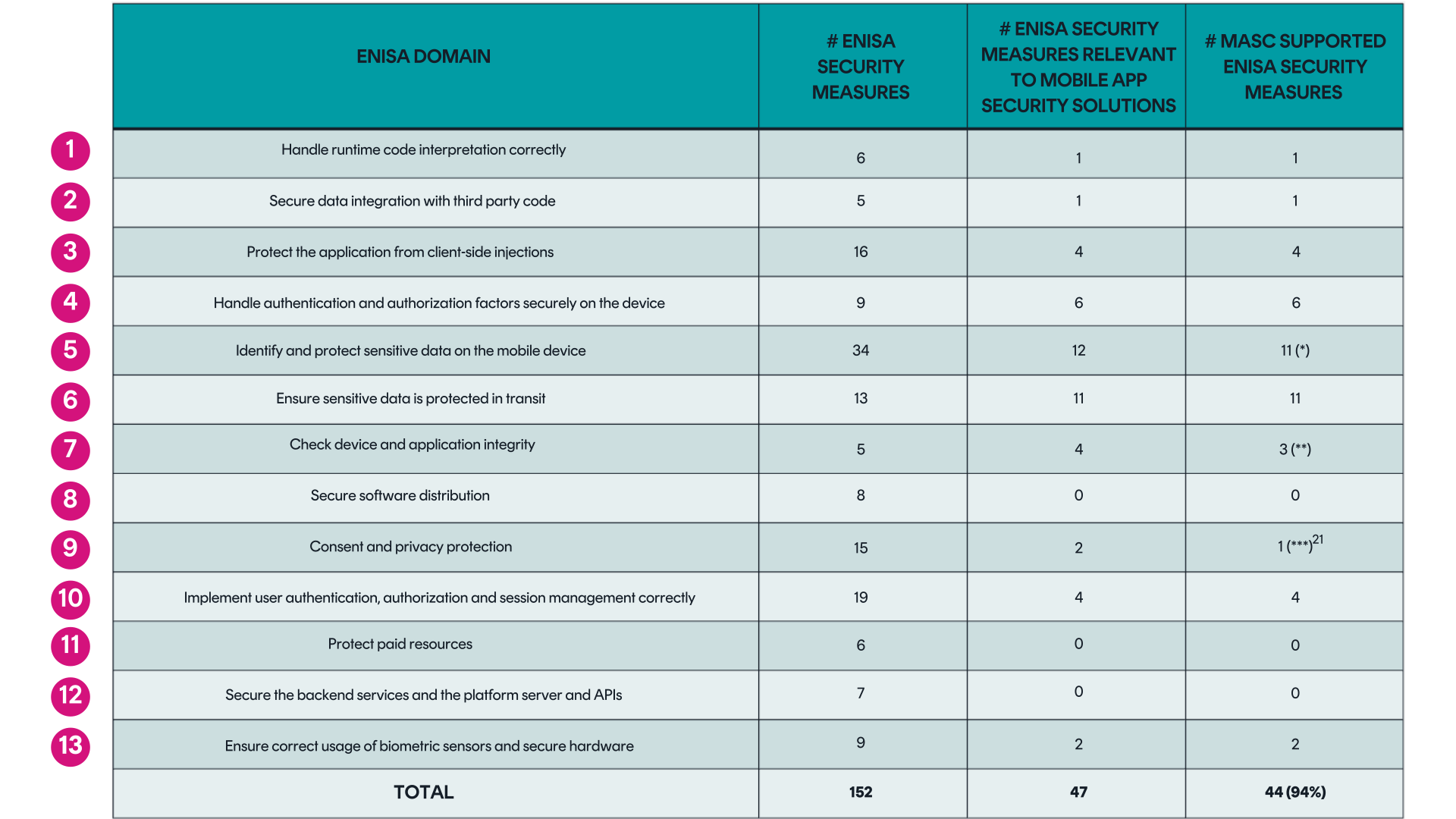 Figure 14: MASC support for relevant ENISA Security Measures (relevant to Mobile App Security solutions)
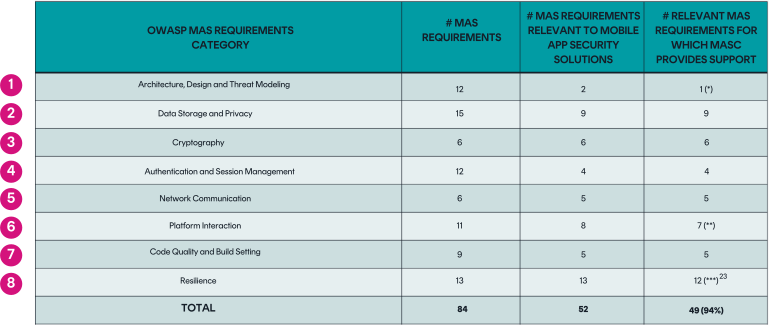 Figure 15: MASC support for relevant OWASP MAS Requirements (relevant to Mobile App Security solutions)
SUMMARY
The EUDI Wallet will likely be part of our daily life, whether it is used to access public services, open a bank account, board an airplane, purchase car insurance, apply for a new job, or some other function. Given the central role it will play, the EUDI wallet will likely be under constant attack from a variety of vectors, including hackers, statesponsored entities and organized cybercriminals. To be regarded as trust anchor, both on a national level but also in all EU member states, as mandated by the revised EIDAS regulation, the EUDI issuer needs to carefully consider its risk mitigation strategy and develop a defense model encompassing both proactive measures and reactive measures. For most issuers, issuing a mobile app with rich and security sensitive functionality on a such a large scale is a new territory.
Foundational to the secure development and deployment of your EUDI wallet is a focused risk assessment and/or threat modelling to gain a comprehensive understanding of the associated risks and/or threats associated with the wallet. This process will be invaluable to ensure and maintain secure operations and user confidence in the mobile app, specifically to:
- Plan and implement the necessary preventive, detective and remediation measures;
- Identify requirements to enhance in-house technical resources & skills, processes and security tooling. Mobile app security is a complex field and requires a skillset that differs from mobile app development and DevOps;
- Reference and update to reflect changes to the threat environment or prior to changes to the wallet app itself.
In addition to providing industry best practice, reputable online resources such as ENISA Smartphone Guidelines and OWASP Mobile Security Standard can be used to reconcile the coverage and effectiveness of your security measures. The Cryptomathic Mobile App Security Core (MASC) fulfills key selection criteria for an effective mobile application security solution to complement your approach to secure software lifecycle development. This mobile security product featuring a mobile app security SDK and a back-end assurance services offers an evolutionary security design, continuously enhanced and refined over 10 years, that provides protection measures to not only be resistant to the threats of today but also responsive to emerging ones. With 94% coverage against ENSIA security controls, MASC is a highly valuable security solution for EUDI Issuers.
Furthermore, MASC does not come at the cost of sovereignty for an EU-based EUDI issuer. Cryptomathic develops, maintains and supports the MASC solution out of Denmark with no external dependencies. With the vast majority of mobile devices being manufactured in China and India, and the operating system owned and developed by US corporations, protecting the core of the wallet app with mobile app security developed and tested in the EU by an EU company provides you with reassurance that you will have control over security measures. The loyalty of MASC's customer base over the decade is testament to its ongoing effectiveness.