PCI DSS AND CRYPTO KEY MANAGEMENT
Your guide to confident compliance and business efficiency with CKMS

INTRODUCTION
PCI DSS, short for Payment Card Industry Data Security Standard, is the payment industry ’ s standard for the protection of credit or debit cardholder account data. The go-to mechanism for compliant protection of such sensitive data is strong cryptography, specifically encryption.
Encryption of data inevitably transfers the value from the encrypted data to the decryption keys that give access to this data. These cryptographic keys are ever-increasing in numbers and must be carefully managed to avoid the risk of theft, loss, or misuse of keys. In short, a strong and robust key management system is needed to protect these vital assets in a compliant way.
This document provides both a high-level summary of how a Key Management System applies to PCI DSS and also a more detailed examination of the specific benefits a centralized and automated system such as Cryptomathic’ s Cryptographic Key Management System (CKMS) can bring to Requirement 3 (Protect Stored Account Data) of the standard.
Exploring PCI DSS Requirement 3 in more detail, this document showcases how CKMS is the ideal key management solution for achieving compliance with PCI DSS¹.
PCI SECURITY STANDARDS
What is the PCI Security Standards Council?
The PCI Security Standards Council (PCI SSC) is a global organization that develops and maintains security standards for the payment card industry. It was founded in 2006 by major credit card companies, including Visa, MasterCard, American Express, Discover, and JCB, in response to the increasing need for standardized security measures to protect sensitive payment card data.
The primary focus of the PCI SSC is to establish and promote security standards and best practices that help prevent data breaches and protect cardholder information. These standards provide guidelines and requirements for organizations that handle payment card transactions, including merchants, payment processors, financial institutions, and service providers. The standards help ensure that adequate security measures are in place to safeguard cardholder data from theft, fraud, and unauthorized access.
The PCI SSC has developed several security standards, with the most well-known being the Payment Card Industry Data Security Standard (PCI DSS). The PCI DSS outlines a set of security controls and requirements to which organizations must adhere in order to protect payment card data. It covers various aspects of information security, including network security, data encryption, access controls, vulnerability management, and more.
Overall, the PCI SSC plays a crucial role in ensuring the security of payment card transactions by providing clear guidelines and standards that help organizations mitigate the risks associated with handling sensitive cardholder data.
What is PCI DSS?
PCI DSS stands for Payment Card Industry Data Security Standard. It is a set of security standards designed to ensure the secure handling, storage, and transmission of credit card information and other sensitive payment data. The standard was created by major credit card companies, including Visa, MasterCard, American Express, Discover, and JCB, to establish a unified approach to protecting cardholder data and preventing data breaches and fraud.
PCI DSS consists of a set of requirements and security best practices that organizations that handle credit card information must follow to maintain the security of their payment systems.
These requirements cover various aspects of security as follows:
Build and Maintain a Secure Network and Systems
-
Install and Maintain Network Security Controls.
-
Apply Secure Configurations to All System Components.
Protect Account Data
- Protect Stored Account Data.
- Protect Cardholder Data with Strong Cryptography during Transmission over Open, Public Networks.
Maintain a Vulnerability Management Program
- Protect All Systems and Networks from Malicious Software.
- Develop and Maintain Secure Systems and Software.
Implement Strong Access Control Measures
- Restrict Access to System Components and Cardholder Data by Business Need to Know.
- Identify Users and Authenticate Access to System Components.
- Restrict Physical Access to Cardholder Data.
Regularly Monitor and Test Networks
- Log and Monitor All Access to System Components and Cardholder Data.
- Test Security of Systems and Networks Regularly.
Maintain an Information Security Policy
- Support Information Security with Organizational Policies and Programs.
Organizations that process, store, or transmit credit card data are required to comply with PCI DSS in order to minimize the risk of data breaches and to protect cardholders from potential financial fraud. Compliance is typically validated through self-assessment questionnaires or third-party security assessments, depending on the organization's size and level of card transaction volume.
Failing to comply with PCI DSS can result in various consequences, including fines, increased transaction fees, legal liabilities, and reputational damage. Therefore, many businesses that handle credit card data take PCI DSS compliance seriously and invest in security measures to protect their systems and customers' sensitive information.
If PCI DSS is in scope for your business domain, each of the requirements listed will be audited and assessed by an PCI DSS approved auditor. Failing the audit will have severe impact on the further processing of account data within the business domain and might cause financial and business-related impacts.
PCI DSS AND KEY MANAGEMENT
The best solution to protecting payment card account data is with cryptography and specifically encryption. For any encryption scheme, the value of the data that’ s protected gets transferred to the cryptographic keys that unlock access to the protected data. These keys are arguably the most valuable data assets a company has: access to encrypted data is only possible if the right key is in the right place at the right time.
For systems that use encryption, to comply with PCI DSS there are specific parts of Requirement 3 (Protect Stored Account Data) that define the expected behaviour in relation to ‘key management’ processes and procedures.
While it is possible to implement key management as a manual process, performed by human beings following written procedures, these schemes typically scale badly and are vulnerable to errors and compromise while being expensive to maintain to the required auditable level.
In contrast, a centralized and automated key management system, such as the Cryptomathic Cryptographic Key Management System (CKMS), is designed to:
- Provide integrity and proof-of-behavior (audit) to processes
- Reduce risks and cost
- Scale economically to the needs of a business.
PCI DSS Requirement 3: Protect Stored Account Data
Requirement 3 of PCI DSS is about the protection of stored account data. In the event that an attacker circumvents a business ’ security measures such as firewall, access control, etc., and succeeds in accessing account data, it is essential that this data is unreadable. This is achieved by encrypting cardholder account data before storing it on files or into databases.
Encryption is the most efficient and secure option only under the condition that the cryptographic keys used for encryption are well protected, controlled, and managed. To this end, the PCI DSS requirements include explicit key management requirements.
PCI DSS lists the following detailed requirements around key management that must be met to achieve PCI DSS compliance in any system that uses encryption.
3.6 Cryptographic keys used to protect stored account data are secured.
3.6.1 Procedures are defined and implemented to protect cryptographic keys used to protect stored account data against disclosure and misuse that include:
- Access to keys is restricted to the fewest number of custodians necessary.
- Key-encrypting keys are at least as strong as the data-encrypting keys they protect.
- Key-encrypting keys are stored separately from data-encrypting keys.
- Keys are stored securely in the fewest possible locations and forms.
3.7 Where cryptography is used to protect stored account data, key management processes and procedures covering all aspects of the key lifecycle are defined and implemented.
3.7.1 Key-management policies and procedures are implemented to include generation of strong cryptographic keys used to protect stored account data.
3.7.2 Key-management policies and procedures are implemented to include secure distribution of cryptographic keys used to protect stored account data.
3.7.3 Key-management policies and procedures are implemented to include secure storage of cryptographic keys used to protect stored account data.
3.7.4 Key management policies and procedures are implemented for cryptographic key changes for keys that have reached the end of their cryptoperiod, as defined by the associated application vendor or key owner, and based on industry best practices and guidelines, including the following:
- A defined cryptoperiod for each key type in use.
- A process for key changes at the end of the defined cryptoperiod.
3.7.5 Key management policies procedures are implemented to include the retirement, replacement, or destruction of keys used to protect stored account data, as deemed necessary when:
- The key has reached the end of its defined cryptoperiod.
- The integrity of the key has been weakened, including when personnel with knowledge of a cleartext key component leaves the company, or the role for which the key component was known.
- The key is suspected of or known to be compromised.
- Retired or replaced keys are not used for encryption operations.
3.7.6 Where manual cleartext cryptographic key-management operations are performed by personnel, key-management policies and procedures are implemented include managing these operations using split knowledge and dual control.
3.7.7 Key management policies and procedures are implemented to include the prevention of unauthorized substitution of cryptographic keys.
From these requirements we gather that procedures and tools are necessary for:
- Managing the entire cryptographic key life cycle.
- Distributing and exchanging securely these cryptographic keys.
As we detail next, CKMS can directly be applied to ensure compliance with all these requirements.
Cryptomathic CKMS
Cryptomathic CKMS plays a significant role in helping organizations achieve and maintain compliance with the Payment Card Industry Data Security Standard (PCI DSS). CKMS is used by major banks, card payment schemes, card data processors and bureaus worldwide, in order to meet the PCI DSS requirements when dealing with credit and debit cards. CKMS is directly applicable to the following aspects of PCI DSS Requirement 3:
- Multi-factor authentication
- Dual control
- Split knowledge
- Entire key-life-cycle management
- Integrity protection of keys and log files
CKMS Architecture
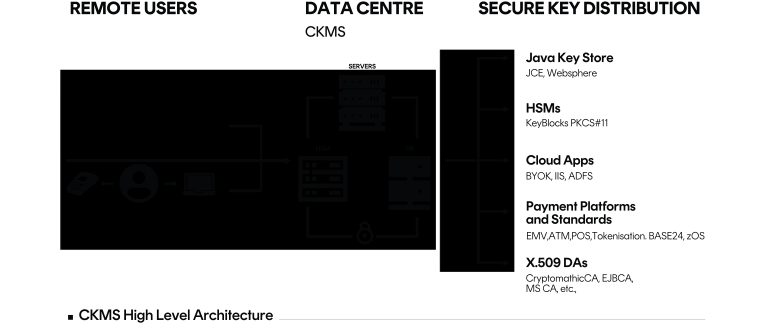
CKMS is built on a resilient client-server architecture. The quality and protection of keys is ensured using a FIPS 140-2 level 3 or higher HSM (Hardware Security Module), with the flexibility to choose from a variety of vendors.
High availability is ensured through clustering of the servers, database and HSMs. Key management administration can be performed without restrictions on time or place via an intuitive GUI, supported by strong authentication using an OpenID compliant Identity Provider (IdP). For remote key import/export and key share printing a compliant key loading device (KLD) is supported. Keys are distributed to applications and HSMs in a wide range of formats (key-blocks). All critical operations are recorded in a tamper-evident audit log.
CKMS provides an intuitive graphical interface to allow users with corresponding privileges to easily manage keys throughout their life cycle from creation through activation, update, disabling, to reactivation or deletion.
As we show next, CKMS can help efficiently comply with specific requirements inside PCI DSS, and there are additional benefits from the adoption of such a world-class key management system.
How CKMS Helps Meeting PCI DSS Requirements
CKMS plays a crucial role in achieving Payment Card Industry Data Security Standard (PCI DSS) compliance by helping organizations securely manage and protect encryption keys used to safeguard sensitive cardholder account data as specified in PCI DSS.
Here's how CKMS contributes to PCI DSS compliance:
-
Encryption of Cardholder Data
PCI DSS requires the encryption of sensitive cardholder data, both in transit and at rest. CKMS provides the necessary infrastructure for generating, storing, and managing encryption keys used for encrypting and decrypting this data. By properly implementing encryption with CKMS, organizations can fulfil the encryption requirements of PCI DSS.
-
Key Generation and Rotation
CKMS allows organizations to generate strong encryption keys that are compliant with the PCI DSS standard. Additionally, PCI DSS mandates the regular rotation of encryption keys to mitigate the impact of a potential key compromise. CKMS can automate the key rotation process, ensuring that keys are changed according to the required frequency.
-
Key Storage and Protection
PCI DSS emphasizes the secure storage and protection of encryption keys. CKMS provides a secure repository for storing keys, using hardware- based security modules (HSMs) that offer tamper-resistant protection. This prevents unauthorized access to keys and meets the PCI DSS requirement for protecting cryptographic keys.
-
Access Controls
CKMS enforces strong access controls over encryption keys, ensuring that sensitive data remains secure. Only authorized personnel are granted access to the keys, optionally only under dual control. This aligns with PCI DSS's requirement to restrict access to cardholder data and limit access based on business need.
-
Audit Trail and Monitoring
PCI DSS mandates the implementation of audit trails and monitoring mechanisms to track key management activities. CKMS provides tamper evident logging and auditing capabilities, allowing organizations to monitor, and document, who accessed keys, when, and for what purpose. This supports compliance with PCI DSS requirements related to logging and monitoring.
-
Centralized Management
CKMS centralizes the management of encryption keys across an organization's infrastructure. This simplifies key management and ensures consistent application of encryption controls, helping organizations maintain compliance across their systems.
Detailed PCI requirements related to CKMS capability
Now we expand on the specific subsection requirements of Sections 3.6 and 3.7 of PCI DSS Requirement 3 and explain the role that CKMS can have in demonstrating compliance.
| PCI DSS REQUIREMENTS | SIGNIFICANCE | CKMS SOLUTION |
|---|---|---|
|
Securing keys that protect stored account data Procedures are defined and implemented to protect cryptographic keys used to protect stored account data against disclosure and misuse that include: • Access to keys is restricted to the fewest number of custodians necessary.
3.6.1 and 3.6.1.x |
This is a procedural requirement which is the foundation for being able to monitor and audit the requirements. Cryptographic keys underpin the security of any encryption scheme. If the quality of the keys is poor – meaning there is some predictable or non-random aspect to them – the security of the scheme can be undermined. Once generated, keys need to be delivered to the required applications for the purposes of encrypting or decrypting sensitive data. |
As mentioned in the Guidance column of this requirement a centralized Key Management system is best practice for achieving the goals of this requirement. Through a Role Based Access Control Model, Key templates defining algorithms and lifetimes, key lifecycle management, tamper proof auditing and reporting, CKMS offers you a wide range of mechanisms to prove the fulfilment of the procedural requirements. |
|
Generation of strong cryptographic keys 3.7.1 |
Cryptographic keys underpin the security of any encryption scheme. If the quality of the keys is poor – meaning there is some predictable or non-random aspect to them – the security of the scheme can be undermined. |
CKMS uses discrete and specialized hardware - FIPS 140-2 level 3 or higher compliant HSMs – for the generation of all critical system and application keys. Key generation is done by the HSM to ensure the required level of randomness (entropy). |
|
Secure cryptographic key distribution 3.7.2 |
Once generated, keys need to be delivered to the required applications for the purposes of encrypting or decrypting sensitive data. |
CCKMS supports both manual and automated secure key distribution. Manually: In clear-text key shares: done via CKMS secure key loading device Encrypted under a Key Encrypting Key (KEK): CKMS allows exporting or importing encrypted keys from file or directly using the KLD. Automatically: Keys are distributed encrypted under a KEK via a push or request protocol. CKMS implements web services (SOAP and RESTFul API) allowing secure and efficient automated key distribution. |
|
Secure cryptographic key storage 3.7.3 |
In aggregating a central store of keys, a key management system provides a treasure trove of data that can have immense value to an attacker. The keys must be protected to a very high standard - in terms of protection from both theft and misuse. |
CKMS stores keys, encrypted under the HSM master key, into a database. The key hierarchy implemented into CKMS allows the renewal of the system keys used to protect application keys. |
|
Cryptographic key changes for keys that have reached the end of their crypto-period 3.7.4 |
Cryptographic keys have the property that if over-used they can become weaker. For example, encrypting a lot of data with single keys risk the possibility of exposing the key used – the key material is said to ‘leak’ . For this reason it’ s good practice to replace or ‘ rotate ’ keys after a predetermined time or an amount of data that has been processed by a key. |
Each key in CKMS has a key profile and an associated cryptoperiod, also called key expiration date. CKMS allows tracking the expiration dates of the keys to plan in advance their renewal. Automated key renewal of keys is supported.ntent here. |
|
Retirement or replacement of keys 3.7.5 |
In addition to expiration of cryptoperiod (above) there are other reasons to change operational keys. An application may be retired; there may be reason to believe a key has been compromised by poor security practice outside of the control of a key management system. In every case it will be necessary to remove a key from use but retain access to it if required in the future. |
The key lifecycle management implemented in CKMS support all the required lifecycle changes so key states can be easily changed in case of a key needs to be retired or replaced. |
|
If manual clear-text cryptographic key management operations are used, these operations must be managed using split knowledge and dual control 3.7.6 |
Exposing users to the ‘ clear text’ of cryptographic keys is not compliant. In some circumstances, it is unavoidable to have access to clear text key shares, where more than one is required to create a full key, e.g., when importing a key from a legacy system. It is good practice to procedurally minimise the exposure of plain text key components but if it is required there must be enforced controls that multiple components will not be exposed to an individual person. |
CKMS implements a Role Based – Access Control model for role and user management. It allows to configure dual control on critical operations. CKMS enforces safe import processes; enables management of keys without any exposure to the plaintext; enforces ‘dual control’ for all critical operations and provides an audit of actions in relation to a key. When exporting or importing keys in components, split knowledge is ensured. Key custodians can ’t see or export key shares they are not responsible for. |
|
Prevention of unauthorized substitution of cryptographic keys 3.7.7 |
The obvious threat to a key is of theft or misuse. However, there is a more subtle attack is where a known key is substituted for a real key. In this circumstance, an attacker could then decrypt sensitive data at their leisure despite other procedures regarding the secure distribution of a key being followed. Thus, it is vital that any key management system prevents substitution of keys and keeps the integrity of the key profiles and key values. |
With the help of dual control on specified tasks and the extensive privilege-based role concept of CKMS the substitution of a key couldn’t be performed without collaboration of multiple persons/ roles. The integrity of the database is ensured through use of MACs (Message Authentication Code) techniques – this prevents the substitution of one encrypted key by another one by using direct database access. |
CONCLUSION
In summary, CKMS meets all the relevant PCI DSS requirements around crypto key management and can help with both a confident compliance to the standard and a general improvement in the protection of these business-critical assets.
.png?width=2000&name=cryptomathic_logo_orange-08%20(3).png)