6 min read

How Banks And Payment Providers Can Turn Regulatory Timelines Into A Crypto-Agility Advantage
In 2026, post-quantum cryptography (PQC) moves from “future planning” to near-term delivery planning. NIST has approved its first three PQC standards (FIPS 203, 204, and 205), giving the industry a concrete baseline to build on[1].
In Europe, EU Member States, supported by the European Commission, have published a coordinated roadmap and timeline. The Commission’s messaging is clear on near-term milestones: start transitioning by end of 2026, and transition protection of critical infrastructures as soon as possible, no later than end of 2030[2][3]. In parallel, the Commission has encouraged deployments via hybrid schemes that can combine PQC with existing approaches (and, where relevant, QKD[4].
For banks and payment providers, the opportunity is bigger than “migrating to PQC.” PQC is the first large-scale test of crypto-agility: the ability to upgrade cryptographic algorithms, key types, and policy safely, primarily through configuration and standard interfaces, without redesigning every application.
Build crypto-agility first and PQC becomes a managed rollout, not a one-time scramble. You also end up better prepared for future algorithm updates, newly discovered weaknesses, and shifting expectations across regulators, supervisors, and sector roadmaps[5].
This article turns current guidance into six practical steps you can start now to build a more quantum-resilient environment, by making cryptography changeable, governed, and repeatable.
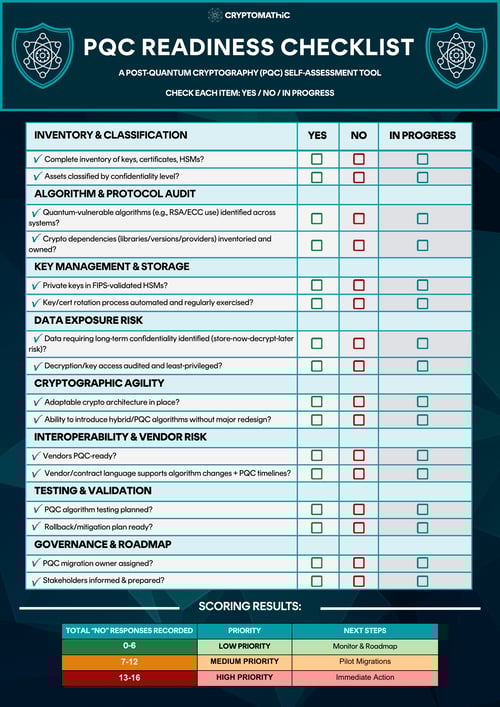
Step 1: Put PQC On The Risk Agenda & Set Up A Crypto-Agile Governance
Start by treating PQC as an enterprise risk, not a research topic. Long-lived financial data such as identity records, signed audit trails, and sensitive archives can outlast today’s cryptography. That makes PQC a board-relevant timeline topic, not just a security engineering one.
Assign a named owner and set an initial transition horizon aligned with external timelines. Establish a cross-functional steering group spanning security, architecture, operations, risk, legal, and procurement. This group should own cryptographic and key management policy, decide when you use hybrid versus PQC-only designs, and ensure PQC is reflected inside existing ICT risk, resilience, and change governance programs.
Add one governance capability most organizations lack: a cryptographic change process. Define who can approve algorithm and key-type changes under normal conditions and under emergency conditions, how changes are tested and rolled back, and how exceptions are documented and retired.
Practical Outputs for Step 1:
- A PQC and crypto-agility owner and steering group charter
- An initial PQC risk assessment and transition horizon
- A cryptographic policy update that covers PQC and hybrid modes
- A defined crypto-change approval and escalation path, normal and emergency
Step 2: Discover & Assess Your Cryptography And Keys, Then Build A Living Crypto Inventory
You cannot migrate or become crypto-agile without visibility. Build an inventory of where and how cryptography is used: algorithms, key sizes, certificate chains, protocols, and libraries. Also capture where crypto decisions happen: TLS termination points, API gateways, SDKs, PKI, signing services, and places where algorithms are hard-coded or constrained by legacy dependencies.
For banks and payment providers, do not stop at “applications.” Make sure discovery covers typical hotspots like:
- Edge and internal TLS and mTLS termination
- Internal PKI hierarchies, issuing CAs, and mutual authentication
- Signing workflows for transactions, messages, batch files, and audit records
- Embedded crypto in vendor appliances, processors, middleware, and SDKs
Map ownership and lifecycle: who rotates what, where keys live, and where unmanaged keystores exist outside formal processes. Automate discovery where possible and integrate with central key management so the inventory becomes a living asset, not a one-off exercise.
Practical outputs for Step 2:
- A cryptographic inventory, essentially a bill of materials for crypto
- Key ownership and lifecycle mapped per system and domain
- A list of unmanaged keystores and embedded-crypto hotspots
- A prioritized list of systems handling long-lived or high-value data
Step 3: Build A Crypto-Agile Foundation With Central Policy, Key Management, And Standard Interfaces
Once you know what you have, modernize how you manage and change it.
Crypto-agility becomes real when two things are true:
- Central control of cryptographic policy and key lifecycle, so standards, rotation, and audit are consistent
- Stable interfaces for applications, so crypto choices are not hard-wired into each system
Deploy an enterprise key management approach that can orchestrate HSMs, cloud KMS, and software keystores while enforcing policy centrally and exposing cryptography through standardized APIs or gateway patterns.
A practical nuance for 2026: PQC enablement will not be “HSM only” on day one everywhere. Many organizations will introduce PQC in software or at gateways first, with strong key protection and auditability, then expand hardware-backed support as capabilities mature. The point of the foundation is that whichever execution path you use, policy and lifecycle stay consistent.
Use this moment to reduce complexity: consolidate on a small, well-governed set of classical algorithms and key types before introducing PQC and hybrid variants.
Practical outputs for Step 3:
- A central cryptographic policy enforced across environments
- Centralized key lifecycle management, create, rotate, archive, retire
- Standard integration patterns, APIs and gateways, adopted for application teams
- A tightened baseline of approved classical algorithms, simplified before PQC rollout
 Learn how banks centralise keys, cut cost, and prepare for PQC. Watch on-demand now.
Step 4: Prepare Infrastructure & Run Hybrid Pilots As Change Rehearsals
With governance, inventory, and a crypto-agile backbone in place, prepare the infrastructure and validate PQC in realistic scenarios.
This includes verifying readiness across certificate profiles and tooling, handshake performance and latency, storage and transmission overhead, monitoring and logging, and new failure modes that operational teams will need to handle.
Where hybrid approaches make sense, use 2026 for contained pilots in realistic surfaces such as:
- Hybrid TLS at the edge for customer and API ingress
- Hybrid mTLS for service-to-service traffic
- A signing workflow for artifacts that have long verification lifetimes
Treat pilots as change rehearsals, not demos. Practice deploying a hybrid configuration, measuring impact, rotating keys and certificates, handling failure scenarios, and rolling back safely. Capture results in reusable patterns and runbooks that can be repeated across your estate.
Practical outputs for Step 4:
- PQC and hybrid readiness validated across key crypto stack components
- Pilot results with performance and operational data
- Runbooks for deploy, rotate, and rollback of cryptographic changes
- Reusable integration patterns for scaling rollout
Step 5: Prioritize Rollout & Embed PQC Into Compliance And Third-Party Management
Use pilot results to drive a phased rollout. Prioritize based on data longevity and sensitivity, external exposure, operational criticality, and regulatory relevance. Start where you have the most control, then expand to customer-facing and ecosystem integrations.
In parallel, embed PQC and crypto-agility into BAU assurance:
- Update cryptography and key management standards to explicitly cover PQC and hybrid modes
- Ensure PQC plans and progress appear in ICT risk and resilience evidence
- Strengthen vendor due diligence around crypto-agility, not just “PQC intent”
Example due diligence questions you can standardize:
- Can we switch algorithms and key types via configuration, not code changes
- Do you support standardized hybrid modes today, and where is it proven at scale
- What is your tested rollback plan if PQC or hybrid breaks interoperability or performance
Practical outputs for Step 5:
- A phased rollout plan mapped to risk and regulatory scope
- Updated compliance documentation, ICT risk, resilience, and control evidence
- Vendor due diligence and contract language reflecting PQC and crypto-agility expectations
- A deployment backlog sequenced by data longevity and exposure
Step 6: Decommission Legacy Crypto & Institutionalize Crypto-Agility As BAU
Treat PQC as the start of continuous cryptographic lifecycle management, not a single migration event.
Maintain a register of legacy and exceptions with clear owners and retirement dates. Keep discovery running so shadow crypto shrinks over time. Plan periodic decommission waves so old schemes do not linger indefinitely.
Measure crypto-agility as a capability. Establish a recurring cadence, inventory reconciliation, algorithm reviews, planned rotations, and decommission waves, so you can respond quickly if standards evolve, weaknesses are found, or expectations change.
Example KPIs that security, ops, and audit all understand:
- Time to implement an approved algorithm or key-type change across target systems
- Percentage of systems covered by centrally enforced crypto policy
- Exception volume and exception age
- Inventory drift, how quickly unmanaged crypto is discovered and remediated
Practical outputs for Step 6:
- A legacy and exception register with owners and retirement milestones
- Continuous discovery and drift detection for cryptographic usage
- A recurring crypto lifecycle cadence, review, rotate, retire
- Crypto-agility KPIs tracked over time, speed, coverage, exception trends

From Roadmap To Implementation: Where Crypto-Agility Platforms Fit
For many institutions, the bottleneck is not awareness. It is the lack of a standardized way to control keys, enforce policy, and execute cryptographic change safely across a complex estate.
When you evaluate, or design, a crypto-agility platform approach, look for four capabilities:
- Central policy definition and enforcement across environments
- Key lifecycle orchestration across HSMs, cloud KMS, and software stores
- Stable, standard interfaces so applications do not hard-code crypto choices
- Automation and auditability for rotation, rollback, and evidence generation
Key management platforms such as Cryptomathic’s CrystalKey 360 can help support the foundation work in Steps 2, 3, and 6 by providing centralized key control and policy enforcement across HSMs and environments, and by operationalizing lifecycle management. Crypto service gateway patterns such as Cryptomathic’s Crypto Service Gateway can help support Steps 3 through 5 by giving applications a stable interface to consume cryptography, so PQC and hybrid changes can be rolled out centrally without modifying every application.
Together, these capabilities help turn the six steps above from a conceptual roadmap into a practical delivery plan, helping banks and payment providers meet emerging PQC expectations while improving control, resilience, and flexibility across their cryptographic estate.
Take the next step toward PQC readiness.
See how banks move from regulatory timelines to executable PQC migration plans. Download the roadmap now.
Footnotes
- NIST announcement of approval of three PQC FIPS (FIPS 203, 204, 205) dated August 13, 2024. (NIST Computer Security Resource Center)
- European Commission press release dated June 23, 2025, stating end of 2026 as the start-transition milestone and end of 2030 for critical infrastructures. (Digital Strategy)
- European Commission roadmap landing page, attributing the roadmap to EU Member States supported by the Commission, and pointing to the coordinated roadmap effort. (Digital Strategy)
- European Commission Recommendation page dated April 11, 2024, describing deployment “via hybrid schemes” that may combine PQC with existing approaches or QKD. (Digital Strategy)
- G7 Cyber Expert Group statement (published via HM Treasury on GOV.UK, January 2026) describing a coordinated migration approach, explicit transition to cryptographic agility, non-prescriptive intent, and noting 2035 as a commonly cited overall migration target in guidance. (GOV.UK)
- U.S. Department of the Treasury press release (January 12, 2026) stating the roadmap is chaired by the U.S. Treasury and the Bank of England, and that the roadmap and timelines are not prescriptive. (home.treasury.gov)